

Outdoor Balls
Regular price
$22.00
Forty holes and a hard shell: the outdoor pattern, in a color you can still see at dusk.
- Ships in 48 hours
- 2-year warranty
- Free shipping $50+
- 30-day play test
| Average weight | 0.9 oz |
|---|---|
| In the box | 6 or 12 balls, by pack size |
About this paddle
Who it's for
These are the balls for playing outside. If your court is asphalt, concrete or a painted school yard, and there is any air moving across it, this is the ball you want. Rec games, drill sessions, a Saturday morning group: all of them call for the outdoor pattern rather than the indoor one.
How it plays
An outdoor ball is built to fight the wind and survive a hard surface, and the hole pattern is the tell. 40 holes, small and closely spaced, is what keeps the flight from wandering on a gusty afternoon. An indoor ball does the opposite, with fewer and wider holes and a softer shell, made for a still gym floor. Take one of those outside and you spend the evening watching it drift.
The face
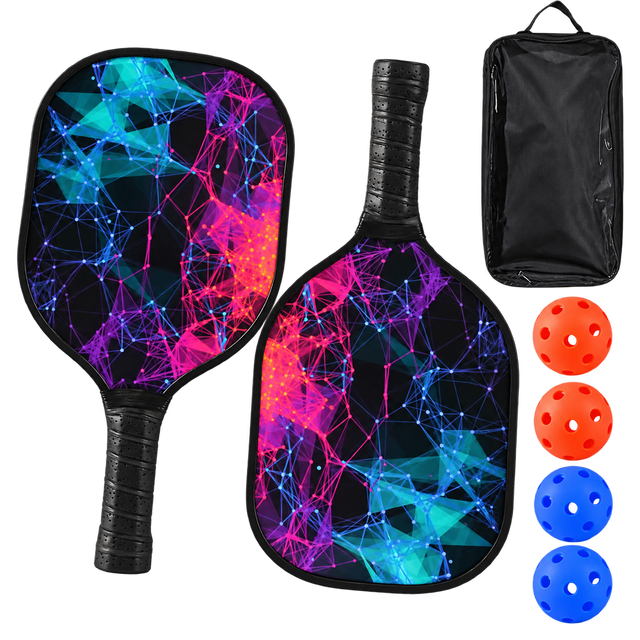
The shell is hard and smooth, with the 40 holes spaced evenly around the sphere. A hard shell is what gives an outdoor ball its sharp bounce off concrete and its clean pop off the paddle face. The colors are chosen to be seen: on a court at dusk, a bright ball is still a visible ball long after a pale one has vanished into the surface.
Weight and balance
Every ball is 2.9 in across and weighs 0.9 oz. That is the whole specification, and for a ball it is all that matters: a diameter you can pick up early in its flight, and a weight that carries without fighting the paddle.
In the box
Balls only, in the pack size you choose:
- 6-pack, a session with spares
- 12-pack, for anyone who drills or runs a group
No paddles are included.
Care and lifespan
Outdoor balls are consumables. Every one eventually goes soft, goes out of round or cracks around a hole, and the harder your surface the sooner. Roll a ball across a flat floor to check it: a wobble means it is finished. Rinse the grit off, keep them out of a hot car, and retire a cracked one rather than let it ruin a rally.
Questions about this paddle
What is the difference between an indoor and an outdoor ball?
Holes and hardness. An outdoor ball like this one has 40 small, closely spaced holes and a hard shell, so it holds its line in wind and survives asphalt. An indoor ball has fewer and wider holes and a softer shell, which suits a still gym but drifts badly outside.
How big are they and what do they weigh?
2.9 in across and 0.9 oz each.
Can I use these indoors?
You can, and plenty of people do. They play faster and louder on a gym floor than an indoor ball would, and they skid more. If the gym is your regular court, an indoor ball is the better tool. If you play mostly outside and occasionally in, these cover both.
Should I take the 6-pack or the 12-pack?
Six is a session with spares. Twelve is for anyone who drills, runs a group, or would rather not drive back for more. Outdoor balls wear out with use, so the larger pack is the one that keeps you playing.
How do I know when a ball is finished?
Roll it across a flat floor. If it wobbles, it is out of round and it is done. Look for hairline cracks around the holes too, because a cracked ball goes dead and behaves unpredictably long before it ever breaks apart.